
Is AES Really Safe in the Quantum Era?
Part 3 of Quantum, explained simply — but slightly deeper insight for decision-makers who want the real picture, not the hype. By Amit Agarwal, CEO & Co-Founder, SeQure AG.
The previous article was unsettling: Shor's algorithm dismantles RSA and the rest of public-key cryptography. So, it is worth saying plainly, up front, that the news is not all bad. The workhorse that scrambles your actual data — AES, the symmetric cipher inside almost every encrypted file, database and disk — does not fall the same way. It faces a different and far gentler quantum opponent, and that opponent runs into a wall that mathematicians have proven cannot be climbed. This article explains why AES-256 is, on everything we know today, comfortably safe — and ends with the one honest caveat that intellectual integrity requires.
What Grover's algorithm actually does
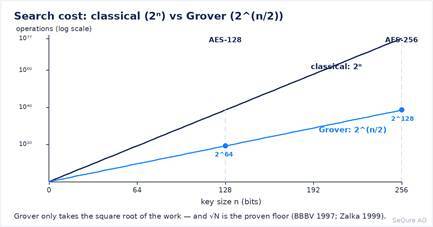
Where Shor exploits the deep structure of factoring, Grover's algorithm of 1996 attacks a problem with no structure at all: searching an unsorted space for the single item that satisfies some condition — the proverbial needle in a haystack, or, for a cryptographer, the one secret key that decrypts a captured message. Classically there is no cleverness available: with N possibilities you must, on average, try about half of them. Grover's remarkable result is that a quantum computer can do it in roughly the square root of that number of steps.
|
The mathematics To find one marked item among N with no exploitable structure: classical ≈ O(N) steps → Grover ≈ O(√N) steps For an n-bit key the haystack has N = 2n straws, so Grover's cost is √N = 2n/2. It halves the exponent — a large reduction, but, as we will see, not a catastrophic one.
Figure 1. Grover takes the square root of the work. The gap is enormous in absolute terms — and √N is the best any quantum algorithm can do. |
How Grover works: amplitude as rotation
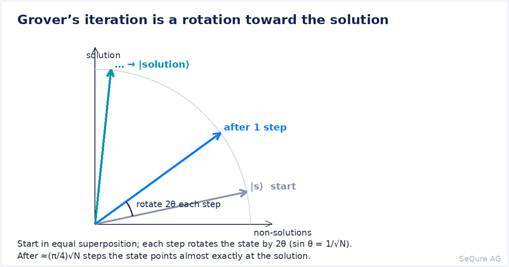
The mechanism is a beautiful piece of geometry. The computer begins in an equal superposition of every possible answer — every straw weighted alike. Each Grover iteration then does two things: an "oracle" step that flips the sign of the amplitude on the correct answer, and a "diffusion" step that reflects all amplitudes about their average. The combined effect is a small rotation of the overall state, in a two-dimensional plane whose axes are "wrong answers" and "the right answer," nudging the state a little further toward the solution each time. Repeat the right number of times and the state ends up pointing almost exactly at the answer — so that when you finally measure, you almost certainly get it.
|
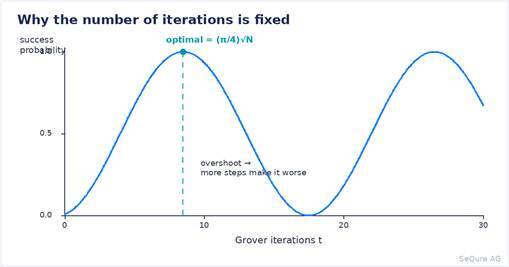
The mathematics With one solution among N, define the angle θ by sin θ = 1/√N. Each Grover iteration rotates the state by 2θ, so after t iterations the probability of measuring the solution is P(t) = sin² ( (2t + 1) θ ) This is maximised when (2t + 1)θ ≈ π/2, i.e. after approximately t ≈ (π/4) √N iterations.
Figure 2. Each iteration is a rotation of fixed size toward the solution. Quantum search is, quite literally, turning a dial. |
A fixed optimum — and why more is not better
That formula carries a counter-intuitive warning. Because the state is rotating, running Grover for too long rotates it straight past the solution and back toward the wrong answers — the success probability rises to near-certainty and then falls again. There is a single right number of iterations, fixed by the size of the search space. You cannot simply "run it longer to be sure;" you must stop at the peak.
|
THE MATHEMATICS
Figure 3. The success probability oscillates. Do too few iterations — or too many — and you miss. The optimum is exact. |
Why it cannot be beaten: a proven ceiling
Now the crucial point, and the one that distinguishes Grover from every moving forecast in this field. The quadratic speed-up is not merely the best method anyone has happened to find. It has been proven to be the best any quantum algorithm can ever achieve for unstructured search. This is a theorem, not a status report.
|
The mathematics In 1997, Bennett, Bernstein, Brassard and Vazirani proved a lower bound: any quantum algorithm solving unstructured search needs Ω(√N) queries. In 1999, Zalka sharpened this to exact optimality: Grover's (π/4)√N is the best possible, down to the constant. The intuition is that each query can increase the amplitude on the marked item by at most about 1/√N, so on the order of √N queries are simply necessary to build it up. The ceiling is a consequence of how fast quantum states are allowed to change at all. |
What this means for AES
Translate the mathematics into key sizes and the conclusion is calm. A brute-force key search over an n-bit key costs 2n classically; Grover reduces that to about 2n/2. In other words, a quantum attacker effectively halves your key length. AES-128 would drop to about 64 bits of security — uncomfortably low, and a reason to retire 128-bit keys for anything that must stay secret for decades. But AES-256 drops only to about 128 bits — and 128-bit security remains far beyond the reach of any computer, quantum or classical, for the foreseeable future.
|
The mathematics classical brute force: 2n Grover: ≈ 2n/2
The remedy for symmetric cryptography is therefore almost embarrassingly simple: use long enough keys.
Figure 4. The asymmetry in one picture: Grover halves the strength, but AES-256 still clears the bar. AES-128 does not. |
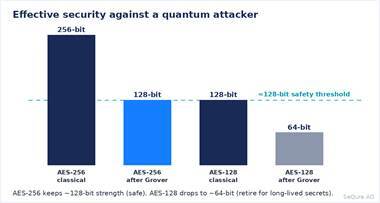
This is the clean contrast at the heart of quantum risk. Shor's effect on RSA is exponential and catastrophic — it collapses the problem entirely. Grover's effect on AES is merely quadratic and manageable — it dents the margin, and a larger key restores it. Public-key cryptography must be replaced; symmetric cryptography mostly just needs to be sized correctly.
The real world is kinder still
Two practical facts make AES-256 safer even than the bare arithmetic suggests. First, Grover's algorithm barely parallelises - dividing the work across many quantum machines yields only the square root of the usual benefit, so the massive parallelism that makes classical brute force feasible buys an attacker almost nothing here. Second, the algorithm is deeply sequential and the circuits are vast; detailed resource studies of a Grover attack on AES put the requirements so far beyond any foreseeable hardware that, for AES-256, the attack is theoretical in the strongest sense. The quadratic speed-up is real; the practical threat to a 256-bit key is not.
A final, honest caveat
And yet a careful reader deserves the limit of the claim, stated precisely. The ceiling we have described is a ceiling on search. It guarantees that no quantum algorithm can brute-force AES faster than Grover — but it guarantees nothing against cleverness of a different kind. The deeper lesson of Shor's algorithm, after all, was that the way to defeat a "hopeless" problem is not to search it harder but to find a hidden structure that turns it into an easier one. Should a mathematician one day discover such a transformation for AES — or a fundamental flaw in its design — the proven ceiling would simply not apply, because the problem would no longer be the unstructured search the proof assumes. In plain terms for the boardroom: the one thing that could bypass this ceiling is a Shor-style structural transformation of the problem — or a fundamental flaw in AES's design pattern — a possibility that is real in principle, but unsupported by more than 25 years of intense cryptanalysis.
That possibility is genuine, and honesty requires naming it. It is also, after more than two decades in which the world's cryptographers have tried in earnest and failed, not something our present knowledge gives us any reason to expect. The right way to hold both truths is this: AES-256 is not safe because an attack is impossible; it is safe because, on everything we know today, no efficient attack exists. That is the strongest statement cryptography ever makes about anything — and time, as ever, will tell.
The takeaway
For a financial institution the practical message is reassuringly concrete. The quantum threat is selective, not total. Your bulk data encryption — provided it uses AES-256, or any 256-bit symmetric algorithm — is in good shape. The real and urgent exposure sits where the previous article left it: in the public-key cryptography used to exchange keys and sign messages, which Shor's algorithm genuinely breaks. A sound quantum-readiness programme spends its energy there, while making sure symmetric keys are sized for the quantum era. At SeQure AG we help banks tell the two apart across their estate — but the mathematics above is the part worth carrying into your next risk committee, because it replaces a vague dread with a precise, defensible picture.
——————————————————————————————
References
1. L. K. Grover, "A Fast Quantum Mechanical Algorithm for Database Search," Proc. 28th ACM Symposium on Theory of Computing (STOC), 212–219 (1996).
2. C. H. Bennett, E. Bernstein, G. Brassard and U. Vazirani, "Strengths and Weaknesses of Quantum Computing," SIAM Journal on Computing 26(5), 1510–1523 (1997) — the Ω(√N) lower bound.
3. C. Zalka, "Grover's quantum searching algorithm is optimal," Physical Review A 60, 2746–2751 (1999).
4. NIST, FIPS 197: Advanced Encryption Standard (AES) (2001); and the NIST Post-Quantum Cryptography security-category framework (AES-128/192/256 as Levels 1/3/5).
5. M. Grassl, B. Langenberg, M. Roetteler and R. Steinwandt, "Applying Grover's algorithm to AES: quantum resource estimates," PQCrypto 2016; and S. Jaques, M. Naehrig, M. Roetteler and F. Virdia, "Implementing Grover oracles for quantum key search on AES and LowMC," EUROCRYPT 2020 — practical resource estimates.
About the author. Amit Agarwal is CEO and Co-Founder of SeQure AG, a Swiss quantum cybersecurity company helping banks and financial institutions identify, prioritise, and remediate cryptographic vulnerabilities before Q-Day. He brings 25+ years across software, SaaS, payments and FinTech and holds a BTech (Computer Science), an MBA, an MAS, and a Quantum Computing qualification from MIT's executive education.



Comments