
Part 1 of Quantum, explained simply — but slightly deeper insight for decision-makers who want the real picture, not the hype. By Amit Agarwal, CEO & Co-Founder, SeQure AG.
Every few months a headline announces that quantum computers will break the internet, cure disease, or both by Tuesday! Underneath the noise sits a genuinely beautiful piece of physics — and a genuinely serious implication for anyone whose business rests on encryption, which is to say, every bank. This piece explains how a quantum computer actually computes, with just enough mathematics to make the ideas precise. The equations are set aside in shaded boxes; you can read the article straight through without them or stop and look closely. Both paths lead to the same conclusion.
Why build a computer out of quantum parts at all?
The idea did not begin as an attack on cryptography. It began as a frustration. In 1981, at a conference at MIT, Richard Feynman pointed out that ordinary computers are hopeless at simulating nature at its smallest scale, because nature down there does not behave classically — it behaves quantum-mechanically, and the cost of faithfully simulating a quantum system on a classical machine explodes as the system grows. His proposal, published the following year, was disarmingly direct: if you want to simulate a quantum world, build your computer out of quantum parts.1
That instinct — later formalised by David Deutsch into the notion of a universal quantum computer2 — is the seed of the entire field. However, it is not a promise of a machine that does everything faster. It is a machine that speaks the native language of physics and, therefore, has an edge on a specific class of problems where that language matters. Holding that distinction in mind is the difference between understanding quantum computing and being sold it.
The qubit: a coin that has not yet landed
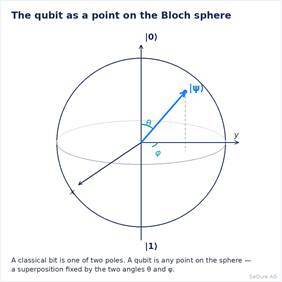
A classical bit is a decided coin: heads or tails, 0 or 1. A quantum bit — a qubit — is the coin while it is still spinning: not secretly already one value, but genuinely a blend of both at once, a state called superposition. We describe that blend with two complex numbers, called amplitudes, attached to the two possibilities.
|
The mathematics |ψ⟩ = α|0⟩ + β|1⟩ The amplitudes α and β are complex numbers (α, β ∈ ℂ). They are constrained so that the state is normalised: |α|² + |β|² = 1 Because an overall phase has no physical effect, every qubit state can be written with two real angles, θ and φ — which is exactly what lets us draw it as a point on a unit sphere (Bloch sphere): |ψ⟩ = cos(θ/2) |0⟩ + eiφ sin(θ/2) |1⟩
Figure 1. A classical bit can only sit at the north or south pole. A qubit is any point on the sphere — the geometry of superposition. |
The catch: you cannot simply read the answer!
Here is the rule that shapes everything that follows. You never get to see α and β. The moment you measure a qubit, it stops spinning and lands on a definite 0 or 1 — and the amplitudes only tell you the probability of each. This is the Born rule3,4, and it is the central frustration of the field: the information is in the amplitudes, but measurement only ever hands you one bit, drawn at random with the weighting the amplitudes prescribe.
|
The mathematics Measuring |ψ⟩ = α|0⟩ + β|1⟩ in the standard basis yields: P(0) = |α|² P(1) = |β|² After the measurement the superposition is gone: the qubit is now simply whichever outcome was observed. You cannot measure it twice to learn more. |
This is why a quantum algorithm cannot just "try every possibility and read them all off." It can hold every possibility at once, but a single measurement collapses that richness to one answer. The whole art, as we will see, is to arrange matters before measuring so that the answer you want is overwhelmingly the one you get.
Gates are rotations — and they are reversible
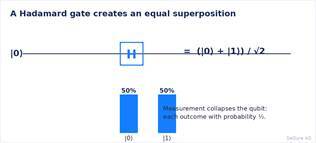
If we cannot read the amplitudes, we can at least manipulate them. The operations of a quantum computer — its quantum logic gates — are rotations of the state, described by unitary matrices. "Unitary" carries a quiet but important consequence: the operations are reversible and they preserve total probability. The workhorse gate is the Hadamard, which turns a definite 0 into a perfect even superposition — it is how you set the coin spinning in the first place.
|
The mathematics The Hadamard-gate H acts as follows:
H|0⟩ = (|0⟩ + |1⟩)/√2 H|1⟩ = (|0⟩ − |1⟩)/√2 As a matrix in the {|0⟩, |1⟩} basis: H = (1/√2) [ 1, 1; 1, −1] That minus sign — a negative amplitude — looks trivial. It is in fact the seed of everything powerful, because amplitudes that can be negative (and complex) can cancel.
Figure 2. One Hadamard gate manufactures superposition. Measure the result and you get 0 or 1 with equal probability — the amplitudes are hidden until you do. |
Entanglement and the exponential state space
One qubit needs two amplitudes. Two qubits need four — one each for 00, 01, 10, 11. Ten qubits need 1'024; 300 qubits need more amplitudes than there are atoms in the observable universe! This staggering growth — the state of n qubits living in a space of 2n dimensions — is the resource quantum computing draws on. It is also why classical machines choke on simulating quantum systems, exactly as Feynman observed.
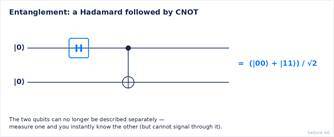
That space contains states with no classical analogue at all. A Bell state3 is the canonical example: two qubits so correlated that neither has a definite state of its own, yet measuring one instantly fixes the other — however far apart they are. This is entanglement, the "spooky action at a distance" that troubled Einstein. It is real, and it is routinely produced in laboratories. One honest caveat, often lost in popular accounts: entanglement does not allow faster-than-light communication. You learn the partner's state, but you cannot use it to send a message — the no-signalling principle holds.
|
The mathematics Two independent qubits combine by the tensor product, |a⟩ ⊗ |b⟩, giving a four-dimensional state space spanned by |00⟩, |01⟩, |10⟩, |11⟩. A product (unentangled) state can be factored into separate single-qubit states. The Bell state cannot: |Φ⁺⟩ = (|00⟩ + |11⟩)/√2 ≠ |a⟩ ⊗ |b⟩ No choice of single-qubit states |a⟩ and |b⟩ reproduces it. That non-factorizability is entanglement.
Figure 3. A Hadamard on the first qubit, then a controlled-NOT, entangles the pair into a Bell state. |
Interference: where the speed-ups actually live
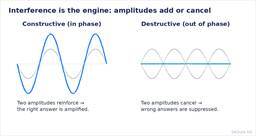
We can now name the real engine. Because amplitudes are complex numbers that can be positive, negative, or anywhere in between, the paths leading to a given outcome can reinforce one another or cancel out — precisely as overlapping waves do on water.
A quantum algorithm is, at heart, a carefully choreographed piece of interference: the computation is arranged so that the amplitudes for wrong answers cancel toward zero while the amplitude for the right answer builds up. Then, and only then, do you measure — and the right answer is overwhelmingly likely to be what you see.
This reframes the whole subject. The power of a quantum computer is not that it tries everything at once and reads the winner. It is that it can make wrong answers destroy each other. Whether that is possible for a given problem depends entirely on whether the problem has a structure that interference can exploit — which is why the next two articles in this series are about the two algorithms that found such a structure, and what they mean for the cryptography banks rely on today.
|
THE MATHEMATICS
Figure 4. The whole game: engineer the amplitudes so wrong answers cancel and the right one reinforces.
|
Why this is not simply a faster computer
It is worth being blunt, because the hype rarely is. A quantum computer is not a faster classical computer. For the vast majority of everyday computing — spreadsheets, databases, payments processing — it offers no advantage whatever. Its 2n-dimensional state space is not free parallelism, because measurement returns just one outcome, sampled by the Born rule. The advantage appears only where a problem's structure permits interference to be marshalled, and for one of the largest and most studied classes of hard problems — the NP-complete problems — no efficient quantum algorithm is known or expected.
There is also a sobering engineering reality. Quantum states are exquisitely fragile; the slightest disturbance from the environment scrambles them, a process called decoherence. Building a machine large and stable enough to run the famous algorithms at scale requires extensive quantum error correction and remains, today, an unsolved engineering problem at the necessary scale. This is precisely why "Q-Day" — the day a quantum computer can break today's encryption (particularly RSA-2048) — is a forecast with a range, not a date on the calendar. The threat is credible and worth preparing for; it is not imminent in the way headlines imply.
What it means for the rest of us
The same physics that makes a quantum computer able to simulate a molecule, or one day break a cipher, is a single coin with two faces: extraordinary promise and a specific, bounded threat. For a bank, the practical takeaway from this first article is modest but important — quantum risk is real, it is selective rather than total, and it rewards institutions that understand it before they are forced to. At SeQure AG, we help financial institutions turn that understanding into an inventory and a plan; but that is a topic for another day. For now, it is enough to see the machine clearly.
——————————————————————————————
References
1. R. P. Feynman, "Simulating Physics with Computers," International Journal of Theoretical Physics 21, 467–488 (1982).
2. D. Deutsch, "Quantum Theory, the Church–Turing Principle and the Universal Quantum Computer," Proceedings of the Royal Society of London A 400, 97–117 (1985).
3. M. A. Nielsen and I. L. Chuang, Quantum Computation and Quantum Information, Cambridge University Press (10th Anniversary Edition, 2010) — the standard reference for the qubit, the Born rule, unitary gates, and entanglement.
4. M. Born, "Zur Quantenmechanik der Stoßvorgänge," Zeitschrift für Physik 37, 863–867 (1926) — the origin of the probability (Born) rule.
5. J. Preskill, Quantum Information, Caltech lecture notes (Ph 219/CS 219) — an accessible but rigorous modern treatment.
About the author. Amit Agarwal is CEO and Co-Founder of SeQure AG, a Swiss quantum cybersecurity company helping banks and financial institutions identify, prioritise, and remediate cryptographic vulnerabilities before Q-Day. He brings 25+ years across software, SaaS, payments and FinTech and holds a BTech (Computer Science), an MBA, an MAS, and a Quantum Computing qualification from MIT's executive education.



Comments